Evidence over claims
Every number on this site comes from a model, a test or a measurement you can reproduce. Where it is still a design value, we say so.
Twinwright started with a question: can a desktop mill come with a twin so faithful that the first cut on the real machine is a formality?
We designed the MC-1 as a parametric CAD model with its drawings, wiring and checks generated from one source, then built its twin from the same data: the controller firmware on a virtual clock, with models of the drives, the spindle, the switches, the cut and the errors of the machine.
Then we wrote that controller firmware ourselves, so that one code base runs on the machine and in the twin, and gave Studio its own CAM: the shape goes in, a program comes out that has already run to the end in the twin. Every claim on this site rests on that kind of evidence.
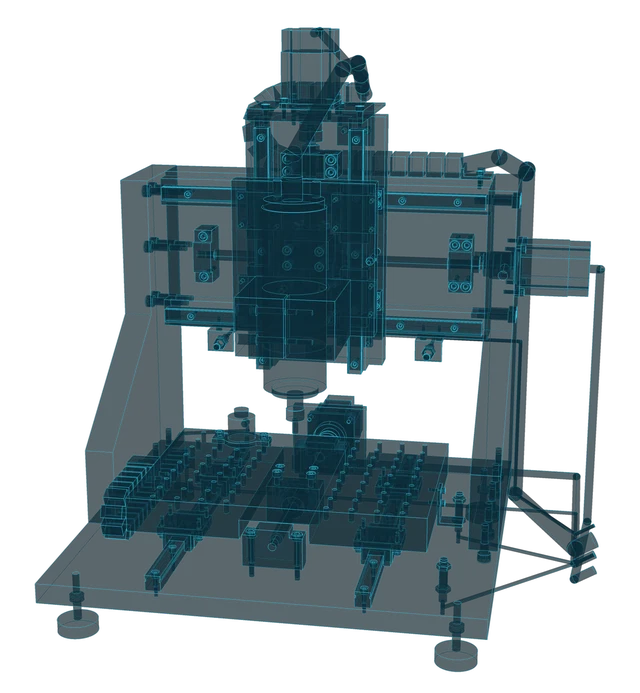
Every number on this site comes from a model, a test or a measurement you can reproduce. Where it is still a design value, we say so.
The controller code in the MC-1 and in the twin is the same, and it is ours. The controller behaviour you see in the twin is the firmware's own, and a firmware fix reaches both at once.
The program and the mill are one product. Each MC-1 is to be measured before it ships, with its twin set to the measurements.
In the twin, an AI may try anything — that is what a twin is for. On a real machine it only reads: the data and its analysis; it never starts a program and never changes a setting. Learning with Studio stays free.