Twinwright MC-1

A desktop mill you can know in advance.

Aluminium, brass and engineering plastics on your bench. Designed in the open, simulated to the millisecond, measured before it ships — and delivered with a twin calibrated to its serial number.

200 × 150 × 80travel, mm
300 × 220table, mm, M6 grid
800 Wspindle, 24,000 rpm
3,000rapids X/Y, mm/min
1.25 µmstep resolution
~57 kgmachine mass
MC-1
MC-1 twin
TwinReal

Status: the design is complete (CAD, 21 drawings, bill of materials, wiring, frame FEA and the digital twin). Prototypes are being built; figures below are design values until measured.

Frame

Machined plate, not extrusion

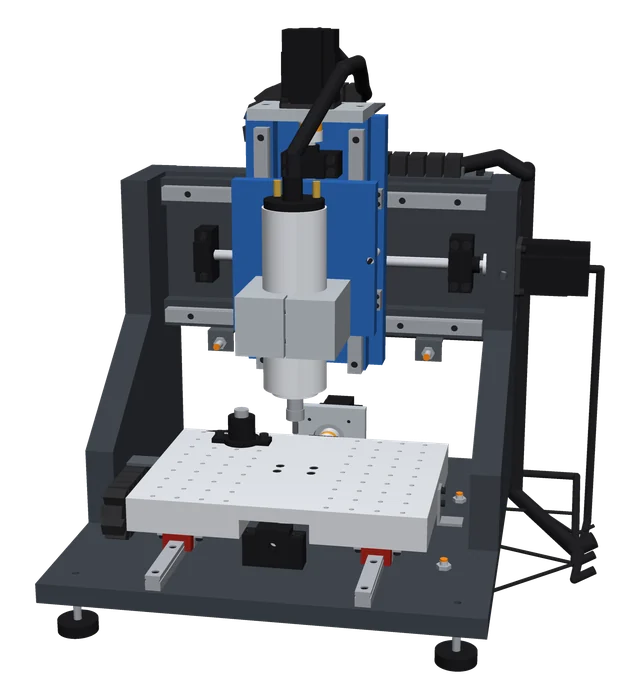
The base, uprights, gantry beam and table are 6061-T6 plates, milled flat where rails and supports sit — 0.02 mm flatness on the rail faces, 0.01 mm parallelism across the beam’s rail bosses. The frame was checked with finite-element analysis before a single part was ordered.

  • Fixed gantry, moving table: the heavy parts stay still
  • About 57 kg of aluminium, plus a separate 9 kg control cabinet
  • Every screw sized and checked for thread engagement in the CAD
The MC-1 at mid-travel, rendered from the production CAD.
Motion

Rails and ball screws on every axis

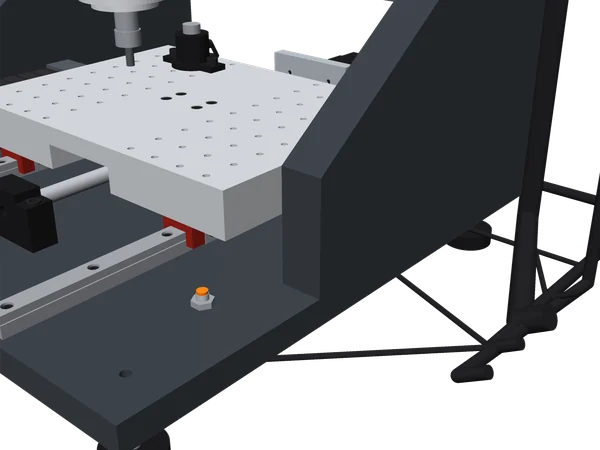
HGR15 profile rails with twelve HGW15CC flange blocks carry the table, the carriage and the Z slide. SFU1204 C7 ball screws sit in BK10 fixed and BF10 floating supports, driven by NEMA 23 closed-loop steppers. The axial stiffness of each drive train is 17 to 30 N/µm, depending on axis and position.

  • 800 steps per mm: 1.25 µm resolution
  • Rapids 3,000 mm/min in X and Y, 1,500 mm/min in Z
  • Drive alarms wired in series into the controller’s motor-fault input
Y axis: twin rails, the ball screw between them, inductive limit switch at the end.
Spindle

800 W, water-cooled, read back

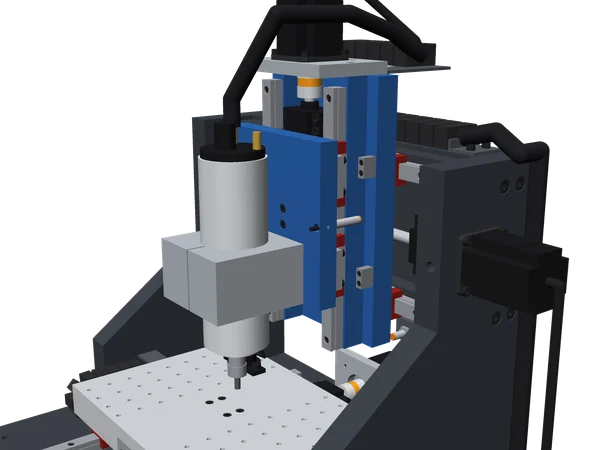
A 65 mm, four-bearing, water-cooled spindle with an ER11 collet (1–7 mm) runs to 24,000 rpm on a Huanyang HY01D523B VFD. The controller talks to the VFD over RS-485, so the speed you command is the speed it reports back — and a broken link stops the job instead of cutting blind.

  • Spindle speed and load read back over Modbus
  • Coolant pump for the spindle loop switched with the spindle
  • At-speed check before cutting starts
Z axis with the spindle clamp, Z ball screw and closed-loop motor.
Control and safety

An electrical cabinet, not a bare board

A Teensy 4.1 on a T41U5XBB breakout runs grblHAL, with separate inputs for every limit switch, the tool setter, the E-stop and the drive alarms. Normally-closed inductive switches fail safe; a tool setter measures tool length. In the steel cabinet, the E-stop opens the contactor that feeds the drives and the VFD, and a start button is needed after every power loss.

  • Two-channel E-stop: contactor coil and controller input
  • No automatic restart after a power cut
  • Separate 48 V drive and 24 V control supplies
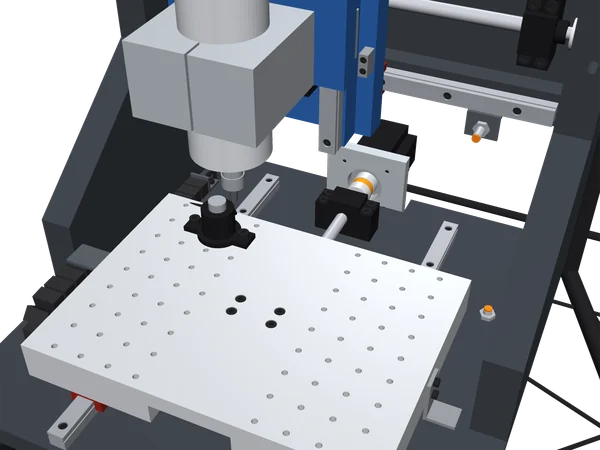
The table with its M6 grid and the tool setter in the rear-left corner.
Your machine’s own twin

Every MC-1 ships with a twin of its serial number.

Before it leaves us, each machine is measured and the results are written into a twin profile that Studio loads. Your simulation then carries the errors of your machine, not of an average one.

The measurements use the tools shipped with Studio (calib_iso230, switch_scan, calib_spindle, calib_cutting); the report comes with the machine.

Positioning
ISO 230-2 lead-error table per axis, with backlash
Switches
trigger points and repeatability of the limit switches and tool setter
Spindle
inertia and friction from a coast-down test
Cutting
force coefficients from a calibration slot in 6061

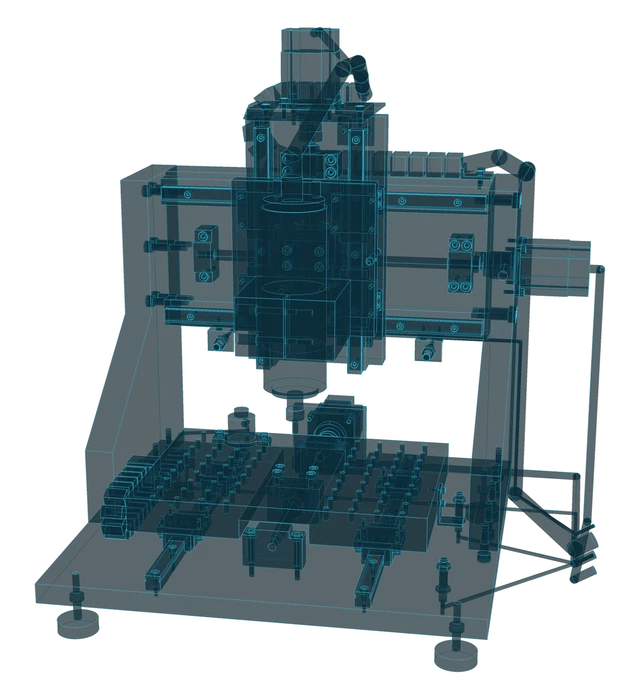
Take it apart on screen.

The same model the twin uses. Switch between the machine and its twin view.

MC-1

Specifications

Working envelope

Travel X × Y × Z
200 × 150 × 80 mm
Table
300 × 220 mm, M6 threaded grid
Base footprint
433 × 428 mm (machine)
Control cabinet
400 × 300 × 200 mm, separate

Structure

Frame
6061-T6 machined plates, fixed gantry, moving table
Mass
about 57 kg, cabinet about 9 kg
Linear guides
HGR15 rails, 12 × HGW15CC flange blocks
Ball screws
SFU1204 C7, BK10 fixed / BF10 floating supports
Axial stiffness
17–30 N/µm per axis (calculated)

Drives

Motors
NEMA 23 closed-loop steppers, 1.2–1.3 N·m
Resolution
800 steps/mm (1.25 µm)
Rapids
X/Y 3,000 mm/min · Z 1,500 mm/min
Acceleration
X/Y 300 mm/s² · Z 200 mm/s²

Spindle

Type
800 W water-cooled, Ø65 mm, 4 bearings
Speed
up to 24,000 rpm
Tool holding
ER11 collets, 1–7 mm
VFD
Huanyang HY01D523B 1.5 kW, RS-485 Modbus

Control

Controller
Teensy 4.1 (i.MX RT1062) + T41U5XBB, grblHAL
Inputs
NC inductive limits X±, Y±, Z; tool setter; E-stop; drive alarm
Senders
ioSender, CNCjs, UGS and other grblHAL senders
CAM
grbl / grblHAL post-processors; Studio's check names what this build refuses

Power and safety

Supply
220–240 V AC, single phase, 50/60 Hz
E-stop
two channels: contactor KM1 and controller input
Restart
start button required after power loss
Guarding
interlocked enclosure with guard locking (in design)

Design values from the CAD and the calculations in the design review. Positioning accuracy and repeatability are measured per machine (ISO 230-2) and reported with it rather than promised here.

Editions

Founders’ machines are hand-assembled and calibrated by the people who designed them.

Prices in
After the first batch

Standard

from$5,490

The same machine, built in series.

  • Assembled and calibrated
  • Interlocked enclosure with chip tray
  • ISO 230-2 report and twin profile
  • 1-year warranty, extendable
Register interest
For builders

Kit

from$4,290

Machined parts and components, you assemble.

  • All machined parts and purchased components, enclosure included
  • Assembly guide with 21 drawings and wiring
  • Calibration tools and a twin template
  • Build support in the community
Register interest

Indicative prices. USD and EUR exclude VAT or sales tax, duties and shipping; CNY includes 13 % VAT.

In the box (Founders’ Edition)

  • MC-1 machine, pre-aligned, in its interlocked enclosure
  • Control cabinet with drives, VFD, controller, E-stop
  • Spindle cooling pump and 3 L tank
  • Cable set with drag chains, pre-routed
  • Tool setter (fitted)
  • ER11 collet set 1–7 mm, starter end mills
  • 75 mm self-centring vise on a subplate
  • Calibration report and twin profile
  • Studio (free) with your machine’s profile

Where we are

  1. Sep 2026Design

    CAD, drawings, BOM, wiring, FEA, design review.

  2. Sep 2026Digital twin

    Studio 0.2: the complete machine, an editor, an optimizer, an MCP server, English and Chinese.

  3. Q4 2026Prototypes

    Build, measure, compare with the twin.

  4. Target Q1 2027Founders’ batch

    Refundable reservations open after the prototype tests.

  5. Target 2027Series

    Standard edition, kits, education bundles.

FAQ

Can it cut steel?

The MC-1 is designed for aluminium, brass and plastics. Light finishing cuts in mild steel are possible; roughing steel is not what it is for.

Which voltage does it need?

220–240 V single phase. A 110–120 V version (different VFD) is planned for North America.

Is there an enclosure?

Yes. Every MC-1 comes with an interlocked enclosure: the spindle cannot start with the door open, and the door stays locked until the spindle has stopped. It is being designed now, together with a safety relay for the E-stop, as the EU machinery rules and China’s GB 15760-2025 require.

Does it have a tool changer?

No. Tools are changed by hand in the ER11 collet; the tool setter measures each tool, and Studio simulates the same workflow.

How is it shipped?

In a wooden crate of about 75 kg, the cabinet packed separately. Shipping is quoted per country.

Join the founders’ list

No payment now. When the prototypes have passed their tests, people on the list get the first chance to reserve with a refundable deposit of $300, in the order they joined.